

Over the past year, we have worked alongside five Community-led High Street Innovators to understand the reality of community-led high street regeneration. As set out in our New High Street Playbook: Community-Led Innovation in Action, these community businesses demonstrate that without the right conditions, even the most determined community-led initiatives struggle to take root.
In our previous blog, we highlighted one of the structural barriers to community-led regeneration of the high street: access to space on fair terms. But communities need more than the ability to occupy a space. They need power to shape the future of their town centres.
What we have seen is consistent. Community organisations are often invited into conversations, but too rarely into decisions. The question is not whether there is a seat at the table. It is whether that table holds real power. Are communities able to influence the priorities and decision affecting their high street? Are they brought to the table with enough time to genuinely influence the outcome? And do councils and other decision makers have the capacity and continuity to work alongside communities as partners over time?
Our Community-led High Street Innovators have helped us further unpack this challenge. We’ve learnt alongside five community businesses negotiating the role that the local community can play in the regeneration of their local high streets. What all these community businesses have in common is that they are creating new ways for their community to have a voice in the regeneration of their place.
Working both inside and outside formal structures
Of our Innovators, Dewsbury Arcade Group is the clearest example of a community business using multiple governance routes to negotiate their place in local town centre regeneration. Operating on a model where Kirklees Council hold the freehold of the town’s Victorian, Grade II listed shopping arcade, and the community curate and manage the space on a 10 year lease, Dewsbury Arcade Group use a range of approaches to engage with their community and the formal governance arrangements in their town.
The Arcade Group use their legal structure as a community benefit society to grow and manage a membership body, while they use a presence in the town centre and a programme of events to engage the wider community. They work to understand what the community wants from their high street and encourage them to travel into the town centre, where footfall has declined by 50% in the past two decades. The Arcade Group does this through using meanwhile space in a vacant retail unit, and hosting community events that attract thousands of people to the town centre.
The Arcade Group also work with local businesses, convening a business network to hear their voices around the regeneration of the high street, and work in partnership with the town’s market, hoping to establish a co-management structure when refurbishment of this town asset is complete.
All of these routes enable The Arcade Group to bring a community-focused voice to the formal governance structures in the town. As an early Pride in Place area, Dewsbury has a Neighbourhood Board, on which the Arcade Group’s Chair of Trustees sits, and another board member sits on a relevant working group.
Does this web of relationships ensure that the community’s voice is valued in the ongoing regeneration of the town centre? An invitation to the table has been made, and The Arcade Group’s Development Director believes more can be made of the distinct value that community businesses and organisations can make to the regeneration of their place.

Creating a collective voice for Birkenhead’s town centre
Through an alliance of five community-focused organisations, called The Leftbank Collective, Make CIC have brought together conversations about the future of their high street, and focused them into shared priorities and a single voice. The Collective has shaped a clearer identity for the town centre, allowed the organisations to speak with a single voice, and increased their legitimacy in conversations with the council and other stakeholders.
The Collective have published a prospectus for the area. They designed branding and created a new communication channel through which they can share and engage with businesses on the high street. They also managed a small grant funding pot for shopfront renewal. This led to the Collective’s involvement in the council’s cultural strategy for the town, and eventually, Birkenhead’s bid to become Town of Culture 2028.
With Birkenhead becoming a Pride in Place area in autumn 2025, this existing work has also enabled the Collective to step into a formal governance role, with Make CIC’s Chief Exec recently appointed as the independent chair of the Birkenhead Central Neighbourhood Board.
Exploring new conversations in support of cultural infrastructure
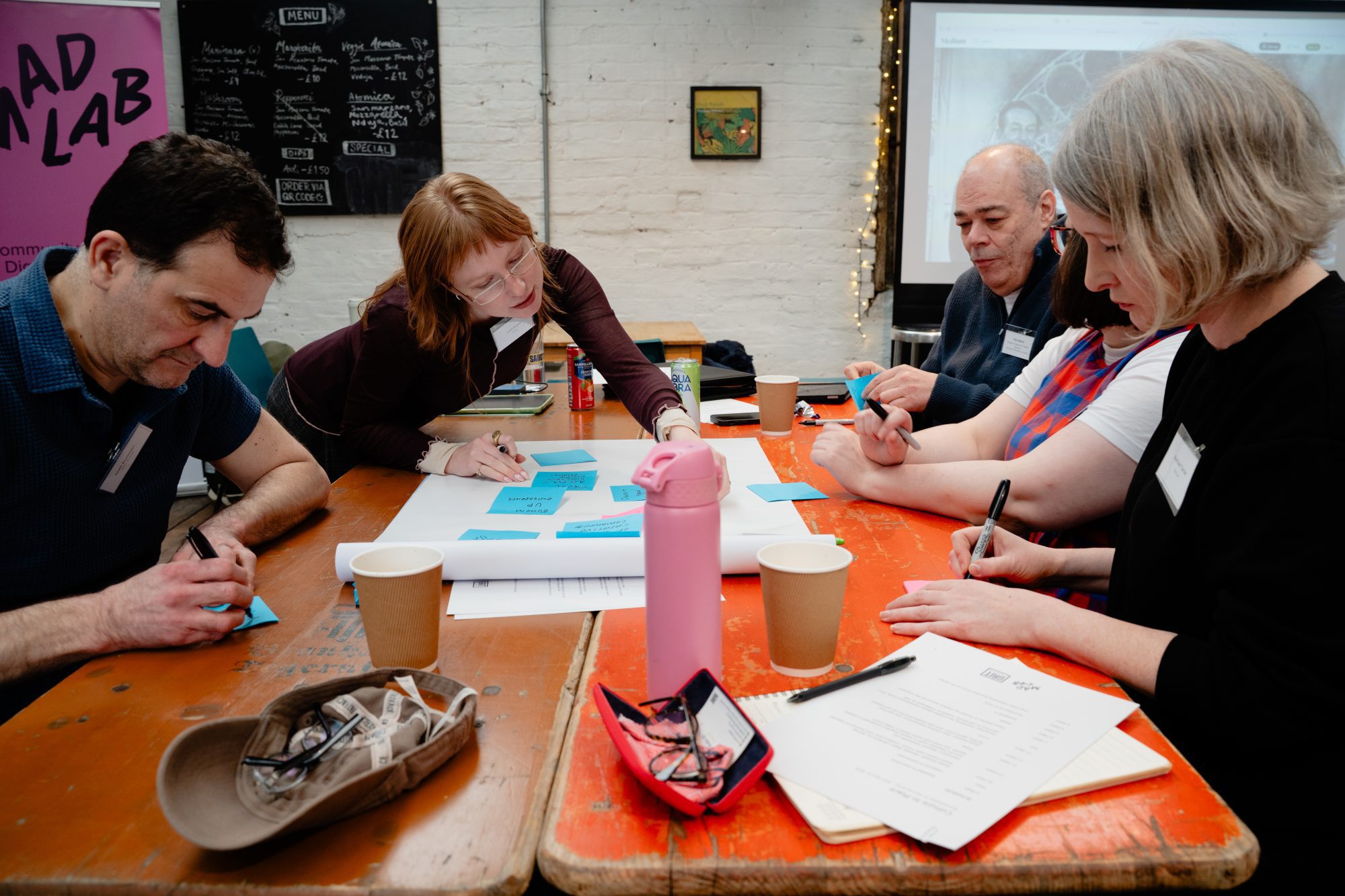
In Stockport, MadLab are working to contest the terms of regeneration and shape a new conversation driven by the community’s needs and ambitions for their town. They have been observing a familiar approach to regeneration arriving in Stockport – one that is driven by developers and threatens to push out the community and creative spaces that have kept the town alive over the past decades.
In response, MadLab have brought together a group of stakeholders to encourage new partnerships and develop pioneering new creative infrastructure for Stockport. Their Culture in Place project seeks to spark conversations between sectors that operate from different perspectives, finding common ground and opportunities for greater collaboration. By exploring how community ownership, cross-sector partnerships, and more inclusive models of development can help creatives stay rooted, they aim to maintain existing creative and community space in the town, and develop a vision for a town centre which foregrounds creative infrastructure and that better serves the community over the long-term.
Building a community mandate and staying the course
In north Bristol, Southmead Development Trust initiated a conversation with their community in 2015, creating a long-term community mandate for change in their neighbourhood. Rather than starting conversations in response to a funding programme or using people or agencies outside of Southmead, the community came together to understand local people’s priorities for their place. They surveyed 900 households to develop the Southmead Community Plan, which has evolved into a regeneration masterplan for the area.
In 2026, the Trust is working to finalise funding to bring the programme onto site. Over the course of a decade, the Trust has held the community’s ambitions for their neighbourhood and negotiated the long road to bringing them to life. Their masterplan will build 177 new homes and new high street space for community use, prioritising smaller homes that match the community’s needs, and bringing public services into the neighbourhood.
Southmead Development Trust’s work illustrates the strengths of community businesses in regeneration – creating change that is rooted in the community’s needs, creating capacity to negotiate processes and institutions that are not designed for communities to interact with, and staying the course over a timeline which stretches over a decade.
Supporting more community power on the high street
Our Community-Led High Street Innovator demonstrator has shown that there is no lack of energy and ambition within communities to create vibrant high streets. However, in the current system, community businesses are too often having to create parallel governance structures to hold community voice, or are treated as delivery partners for regeneration activities rather than equal partners in designing and delivering the regeneration itself.
Bringing a civic high street model to life will require a combination of stakeholders each playing to their strengths, and community businesses have a valuable role to play in enacting regeneration that is locally rooted, trusted and durable.

