Before it became the organisation we know today, myself and Caroline Macfarland were hired as consultants to write the business plan for Power to Change. Caroline was the brains; I made the tea.
We travelled the country meeting brilliant community businesses so that their inspiration could guide the organisation’s future strategy. We sat in cafes with our laptops – there was no office yet – and wrote ideas for grant programmes. We then had these ideas put through the grinder by Power to Change’s new, incredibly smart board members.
We regularly met in Chieveley Services on the M4 with the then-Chair of Power to Change, the late Richard Handover, former boss of WH Smith and hero of the Ladbroke Grove train crash, who lived nearby. We were mentored, supported and challenged by his fine and honourable mind. We interviewed investors who might handle the endowment and pretended to understand a word they were saying. We were given short shrift by Warren from The Bevy community pub in Brighton for not being good enough…so we put him on our advisory panel, along with other trailblazers in community business like Brian from SAFE Regeneration in Bootle and Jess from Hastings Commons.
And finally, we arrived, terrified, in a very big room full of very many board members of the National Lottery Community Fund where the decision was given: our plan was approved, the fund would go ahead, and Power to Change was born.
The funny thing is that all the time we were doing this, we were also setting up our own stuff on the side. Caroline went on to establish the think tank, Common Vision. I was setting up something called Camerados in my bedroom. A growing movement of people from Blackpool to Baltimore who get through tough times by looking out for each other.
The thread of isolation
The goal of Camerados was to fill the gap left by my 20 twenty years of failure working mostly in the homelessness sector. I’d spent 20 years processing people through a system that wanted them to have housing and money. Useful things, but not the reason they were homeless or the way out of it. For me, people need two things – friends and purpose – and without them, their life won’t work. I’d been banging on about it for years so finally it was time to do something about it.
Like Power to Change, things have changed since working in my bedroom or in cafes on laptops. After ten years of mistakes and learning, Camerados now spans six countries, with more than 300 public living rooms bringing people together worldwide. These are the main vehicle of the movement; a place that communities set up where there is no agenda, where people can mix, disagree well, have each other’s backs, and not have to achieve anything for the time they are there. Except, of course, they do. Connection does that to people. Our learning partners have shown that 85% of people feel happier, 1 in 2 feel more able to cope with life, and 73% feel less lonely from getting involved. We’ve produced a big shiny ten-year learning report but to be honest, the real success is that every day more boxes go out around the world to more communities who tell us this is what’s missing in their neighbourhood – from Kansas to Kilmarnock.
We watched the world, but not each other
We don’t all walk around every day thinking about the arc of history and its impact on us, but let’s take a look at the last decade. Social media became the focus of our attention, rating us, curating what we see, including news and opinion. Donald Trump and other populist figures have fuelled ‘culture wars’, driven by algorithms that lead us into increasingly polarised ideological spaces. A global pandemic made isolation compulsory, and the ensuing cost of living crisis meant we couldn’t afford to break that isolation and go out. And actual wars broke out. We’ve watched it all play out on screens, increasingly drawn to our phones and not the person opposite us. It’s a perfect storm for isolation and polarisation.
Camerados is the least innovative idea anyone could have, but it’s chronically missing and massively needed. When I ran homeless hostels, there was a death every 16 days, and they were all linked to isolation. It’s a killer – and it’s a thread running underneath almost every social problem. It links to addiction, mental health, and the growing conversation about young men being radicalised through toxic masculinity and incel subculture, as highlighted by the drama Adolescence.
Like Power to Change, our ten years have shown there is space for something that isn’t charity, that isn’t a service, that feels more mutual – maybe because it is owned and run by the people who use it. The business world has known for decades how to imagine how people will feel when they buy or experience a product, yet the world of delivering social good, whether in the public sector or charity, has never done this. We just assume the hierarchical model is the only one available to us: some people are clever and generous and are here to tell you what you need and fix you, while others are feckless and need to be fixed and should be grateful. Funnily enough, this doesn’t feel too great to those on the receiving end. With a community business or a Camerados public living room, we run things for ourselves and each other, so we know how it feels, and we make sure it feels great.
We call it ‘radical mutuality’ in Camerados, because it seems the world needs a jolt to remember things are better when they are equal and mutual. We call this jolt the ‘sugar question’ after a fella wandered into a public living room in Camden Town and told us “You’ve run out of sugar!”. “Well, you’d better go get some then” said someone from the sofa. It stopped the fella in his tracks. He walked out, but he returned 10 minutes later with a bag of sugar and announced to everyone “We have sugar now!” and everyone cheered. That’s all it took to jolt him into realising this place was run by all of us. That is standard fare for every community business, where everyone has the power to change things.
We don’t need to agree, we need to connect
When I think of the decade to come, it’s hard not to imagine a worrying picture. A struggling economy, accelerating inequality, and fragmented politics can lead us to bad places. Rather than leaning into increasing polarised political narratives and our siloed spaces, there’s an urgent need for voices that bridge divides and help us understand each other.
We ran a campaign last year called “Dunk Off”, where people sat down with someone with whom they actively disagreed and dunked their biscuits in their brew; the first to fall in lost the argument. They laughed and saw each other as human. Reaching an agreement wasn’t the aim, they just disagreed well. I think we’ll be doing more and more of this in the next ten years, to counter the division and hostility which seems to be occurring. And it starts in our own neighbourhoods. Flags are going up where I live, so I gave a talk on polarisation and invited councillors and supporters from across the political spectrum. We’re now going to hold a regular ‘disagreement cafe’ (we’re calling it “Grub & a Gripe”) so that the vitriol on our local Facebook pages can be diffused by a bit of face-to-face disagreement over a bowl of chilli in a local cafe.
Of course, the work I’m doing is driven by citizens, people trying to make their own places better. But there’s a role for government too – even if sometimes that’s just to turbo-charge the work of brilliant people and communities and get out of their way.
Making the difference
Ten years of Camerados and Power to Change has given us ample insight into who is doing brilliant stuff and where. The further we get from knowing the names of people whose lives our decisions affect, the less wise, informed and effective those decisions are. So, we need to back the people who know people’s names. Power to Change and Camerados know so many of these people. I wish decision makers would simply ask us who they are – from Wigan to Dover, Belfast to Port Talbot – and really see the difference they’re making. Trust them, and back them. That’s how you build a better Britain.
If you’re running a successful community business, the chances are you actually care about the right things and are tremendously gifted – it’s NOT easy! Camerados’ public living rooms are much easier to start and run, but in reality, it still takes guts and real insight into your community – and that’s exactly why policymakers and government should pay attention. The people using public living rooms are also the people who don’t show up anywhere else. Our recent data shows that a third of people who use them don’t have any other social groups in their life. So, these are the people and places to listen to, to empower and – most of all – to trust.
And for the rest of us, we can be part of this movement too. The ‘power’ in Power to Change has never come from that £150 million endowment Caroline and I helped convince the Lottery to commit. The power came from all those people we met and the energy they put into communities because they give a damn and they give their time. You have that power too.
As Hollie McNish said in a brilliant recent poem, if you want to “get your country back”, then do something. It’s not hard to find out what your town needs. Surely, if we’ve proved something in the ten years of existence – Power to Change or Camerados – it’s that we have the power. Will you use yours?
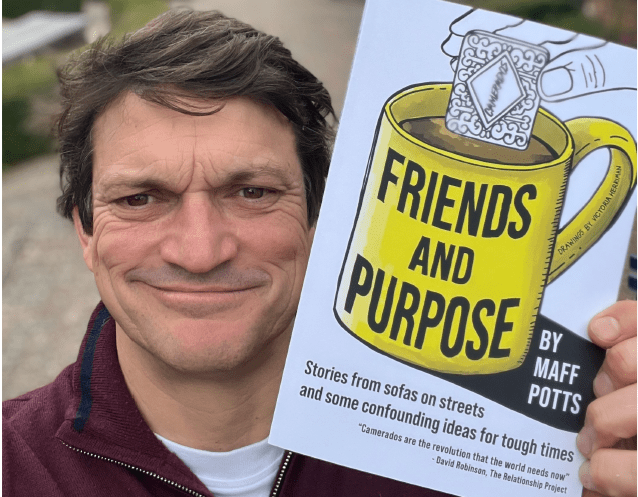
Maff Potts is the Director of the Association of Camerados. Maff left the traditional forms of social change in 2015 when he set up the worldwide social movement, Camerados, which holds over 240 ‘Public Living Rooms’ in libraries, parks, hospitals, or community spaces.