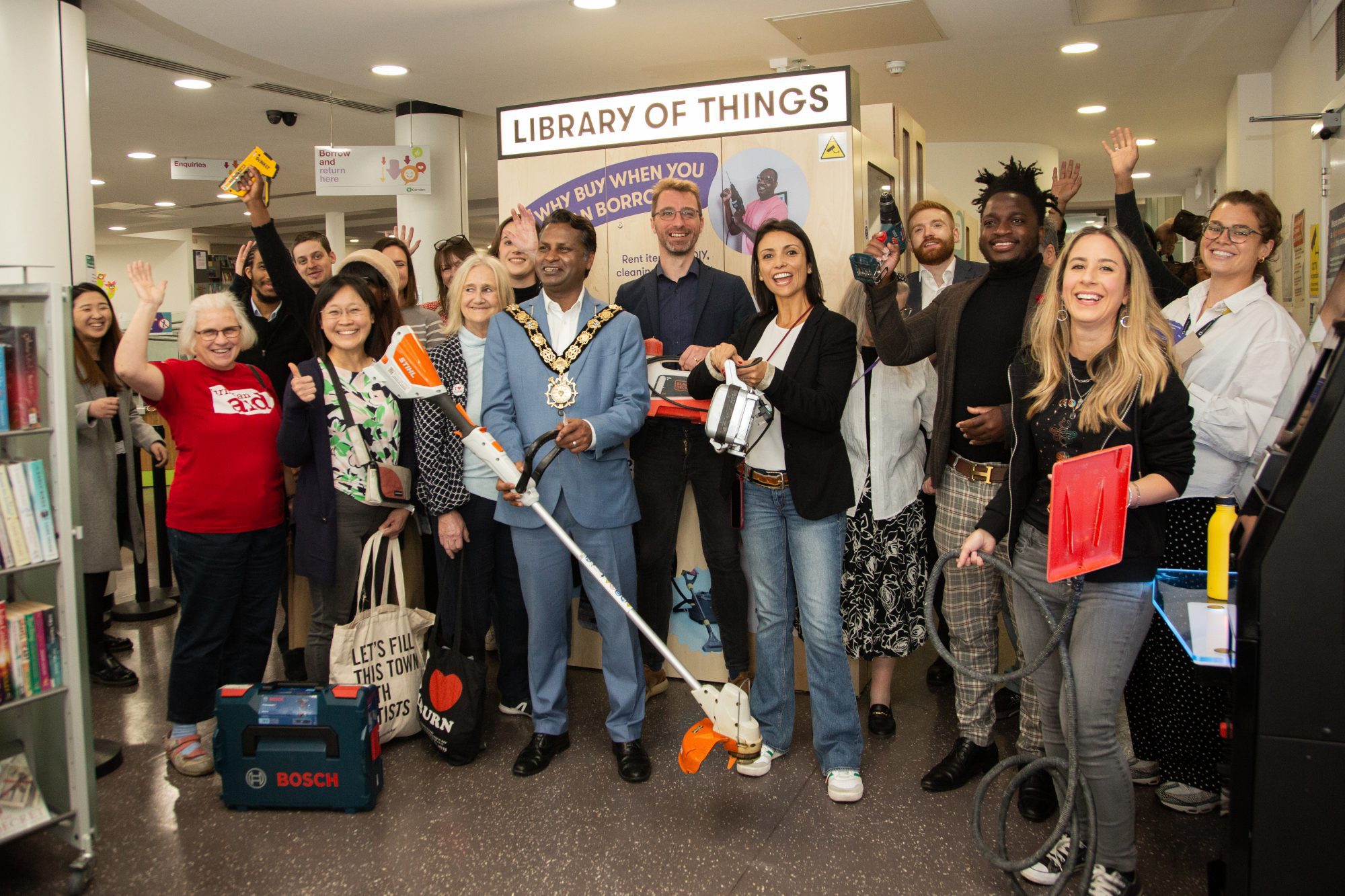
From the civic might of Middlesborough to the coastal cheer of Hastings to the quiet resilience of the Medway towns, I have seen first-hand how community-powered initiatives with place at their heart can directly change people’s lives. These stories are rarely told. It is simply the nature of news that we, as journalists, are far more likely to report on a place making headlines for reasons of tragedy or tension than recovery and strength.
But Britain’s recent spasms against social cohesion highlight the urgency of this untold story. It is the places where disconnection – not immigration or other demographic trends – is at its greatest that were most likely to suffer from riots in the summer of 2024, after all. ‘This Place Matters’, a report by Citizens UK, UCL Policy Lab, and More in Common, found no consistent correlation between high immigration to an area and low social cohesion.viii Rather, the constituencies that experienced unrest all have populations where more people report feeling “disconnected” than “connected”.
Maintaining civic pride against the odds
When our smartphones serve as our social network, shopping precinct, entertainment venue and library, place-based connection matters more than ever. What improves connection? Free and accessible venues where anyone can gather. High streets that offer more than shuttered shopfronts, bookies and dizzying volumes of vapes. Community businesses that invest in their local clientele and locale. And, yes, funding from local and central government to rebuild public services and the public realm after the age of austerity.
As Britain editor of the New Statesman, I have the privilege of travelling regularly around the country to see for myself how residents, businesses, charities, councils and all the doers in between are responding to the way politics buffets their neighbourhoods. I often come away from such trips with conflicting feelings. Respect for, and no little relief at, locals maintaining civic pride against the odds. But also despair at how little help they receive, and how ragged so many places in this rich country of ours have been left to become.
Reclaiming disused and unloved spaces – whether sold off by straitened councils or neglected by distant landlords – is crucial to a neighbourhood no longer feeling ‘left behind’. One of the most striking pieces of polling that has ever crossed my desk as a political journalist was a survey by the polling company Survation: when asked what their neighbourhood most lacks, the top thing people in 225 ‘left behind’ neighbourhoods identified by Local Trust was: ‘places to meet’.ix This was put above the need for more jobs, housing, transport and healthcare.
Community businesses tackling local challenges
I was fascinated during a trip to Hastings on the east Sussex coast to see how vibrantly a community business was responding to the problems of a town battling high deprivation and high housing costs. Hastings Commons, a grassroots group that could be described as part-social enterprise part-community land trust, has since 2014 been buying up and renovating ‘derelict and difficult’ buildings in the town centre, plus a network of caves carved out of the cliffside, for community use and public good.
On my tour, I saw 12 flats rented out at affordable rates retrofitted into a reclaimed Sixties ex-office block, a shared working space with similarly low fees installed in the former printing presses of the Hastings and St Leonard’s Observer, and an old Victorian cottage of hireable classrooms, artists’ studios and a common room. The spaces bought up and done up by Hastings Commons provided social events like community barbecues as well as tech workshops and a youth club. It was a lesson in corralling grants and loans from hundreds of organisations (including Historic England and the National Lottery), as well as in the potential fruits of the government’s new Community Right to Buy and powers of compulsory purchase – pushed for by Power to Change.
I have also witnessed how community businesses can play other, less direct roles in reviving an area. During a visit to Luton Road – often characterised as notorious for antisocial behaviour – in the Kent town of Chatham, I joined Arches Local community workers who had commissioned street art, run a pop-up farm and planted trees around the place. They also used the generous backyard of a much-loved local motorcycle shop for events and parties for locals. We spoke to the owner of the local business who had a clear stake in community cohesion as well as serving his customers.
In Middlesborough town centre, I spoke to a representative of the central shopping centre – perhaps not a company that would usually be viewed as a community business – who explained why they were so keen to give over empty units for no rent to the Camerados network of public living rooms: free, all-inclusive spaces of fairy lights, children’s toys, cups of tea and biscuits where anyone can drop in for a chat and a sit-down and even a strum-along on a guitar.
Pride in Place
These are different manifestations of businesses working for community good, but they are all united by a stake in improving lives for locals. It is key for the state to create such conditions with programmes targeting funds to particular neighbourhoods, such as the Pride in Place strategy.
We know now the impact of such schemes, from a landmark study by the Independent Commission on Neighbourhoods, which tracked the results of Big Local – a 10-15-year scheme that granted £1 million each to 150 areas across England in 2012 for residents to spend as they pleased. The study found that labour markets in Big Local areas remained more resilient than their non-Big Local equivalents, and that they experienced a steeper fall in overall crime and antisocial behaviour: total crime fell by nearly half in Big Local areas. For the £102 million spent on the programme, there were £323 million in direct savings, plus a £1.1 billion wider benefit over five years.x
Similar findings were revealed in a 2024 report by the Institute for Fiscal Studies on the first causal links between the closure of youth clubs and levels of education and crime.xi Comparing neighbourhoods where there were youth club closures in the austerity years with those where there weren’t, the economist behind the report, Carmen Villa, found teenagers in the affected areas performed nearly 4 per cent worse in exams, and were 14 per cent more likely to commit crime. For every £1 saved from closures, she found associated losses of nearly £3 due to “forgone returns” to education and crime costs.
With the social cohesion and economic cases clear, Labour is wise to follow the place-based investment of the New Labour years (most visible in Sure Start centres and the New Deal for Communities) with Pride in Place funding and legislating to give communities greater power over local assets in the English Devolution and Community Empowerment Bill. While often accused of lacking vision, the government is clearly serious about neighbourhood renewal. It has invested £2 billion more in its first year on what the Independent Commission on Neighbourhoods defined as ‘Levelling Up’ initiatives than Boris Johnson did in his first year, and is on track to invest three times the levels under Johnson – the last politician to speak seriously about place renewal.
Learning from what didn’t work to build what will
However, Labour must avoid the pitfalls of the Levelling Up and Towns Funds that we saw under the Conservatives. For example, funds should not be tied up at council level, which can disempower grassroots groups, funnel money to budgets where cash-strapped local authorities need it most, or result in superficial smartening up of the most tourist-focused and least residential areas (such as the seafront of a coastal town). Councils instead must be funded adequately, requiring the long-promised overhaul of social care.
Labour must also avoid a north versus south narrative: the new Index of Multiple Deprivation – the first since 2019 – shows the biggest deprivation increases not in the north but the south, with poor old Jaywick in Clacton yet again England’s most deprived place.
But perhaps most pressingly, Labour must weave its own narrative of saving our neighbourhoods. It is outspending Boris Johnson on so-called ‘Levelling Up’, but that is a calculation covering 46 disparate schemes and funds, with no label like Johnson had to hang it all together. While storytelling and slogans may sound like a shallow concern, the government by its own admission needs to be known for making a tangible difference to voters’ lives by the time of the next election.
Community power
As Power to Change polling shows, the public is supportive of the government’s community empowerment policies when described to them in a survey, but recognition of them is low. Around half of Britons think the Community Right to Buy and the Plan for Neighbourhoods regeneration scheme (the predecessor to the Pride in Place funds) reflect positively on the government. However, the proportion of the public aware of each of these policies is below 43 per cent – far below other policy announcements made in Labour’s first year in office.
Following Brexit, there was much handwringing among the political class about the failure to properly label and signal infrastructure that was a result of EU funding. Perhaps the government should learn from that, and find a language and visual vernacular for its very sincere focus on community empowerment – and put its mouth where its money is.