
These partnerships are helping us to understand how space is used in Stockport: building a data-driven case for supporting and developing new long-term cultural infrastructure, whilst also working to secure a new public HQ for MadLab. We’re also exploring how the creative industries can continue to grow and develop in Greater Manchester, in line with the combined authority’s Creative Industries Sector Development Plan, and against a global trend of declining creative space in major cities worldwide.
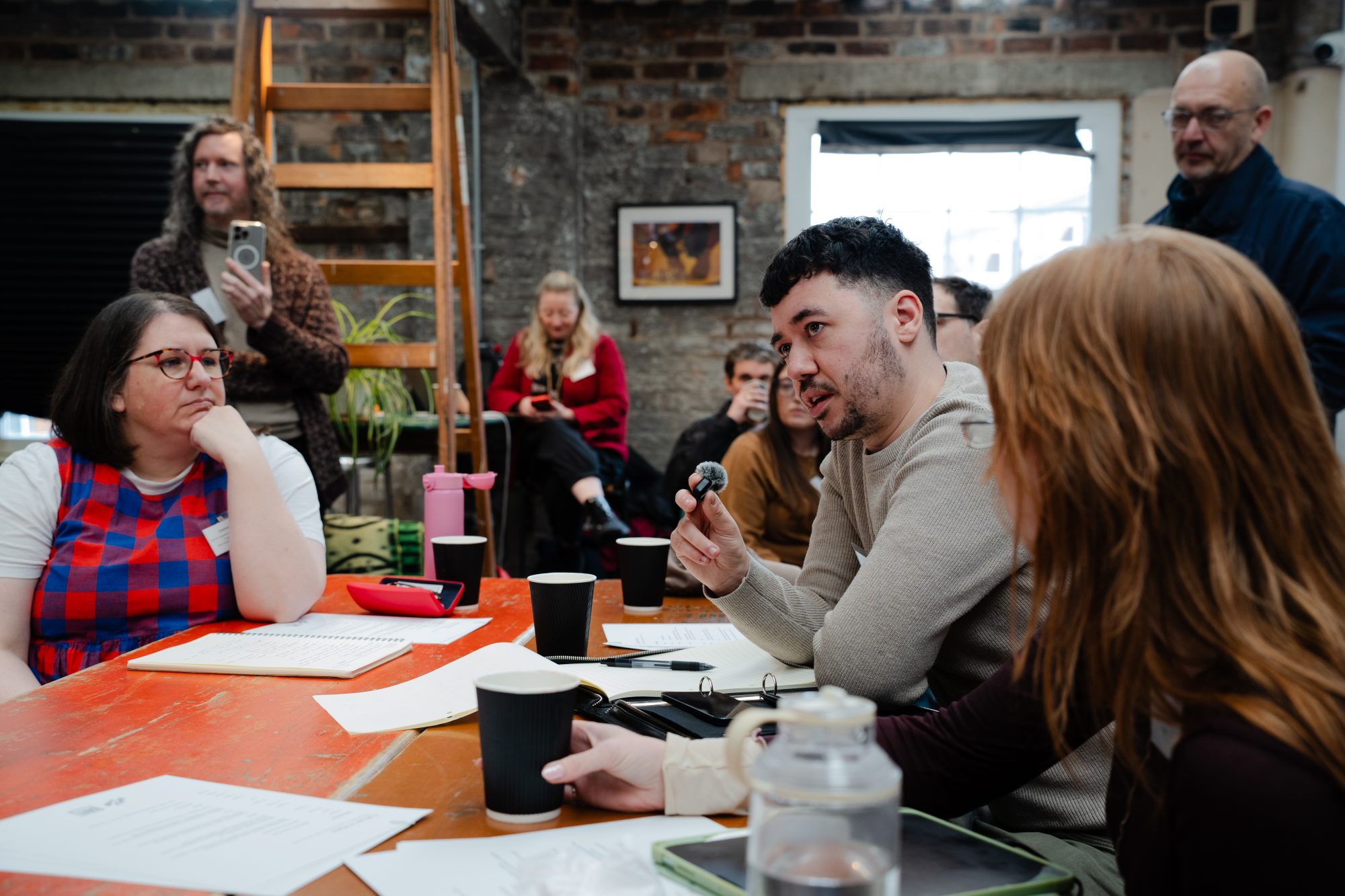
Inspired by the Left Bank Collective in Sydney, Australia, and their Making Space for Culture programme, MadLab is bringing together the creative and community sectors, along with stakeholders from the property and public sectors, to encourage new partnerships and develop pioneering creative infrastructure in Stockport and across the region.
What we’re learning
Each sector has its own needs, drivers, and practical requirements — but there is a genuine appetite for shared discussion about the ‘possibility spaces’ for creative-led regeneration in Stockport, Greater Manchester and beyond, and to test models and approaches that might work locally. Our work in Stockport is exploring how community ownership, cross-sector partnerships, and more inclusive models of development can help creatives stay rooted, capture value, and contribute to local high streets and town centres in ways that last.
This is not a quick fix. It requires collaboration across sectors, shared learning, and a willingness to test new approaches. What’s clear is that this work matters. It matters not only for the creatives, but for the communities they are part of – to create high streets that are more resilient, and where more communities have a real say in how their neighbourhoods, high streets, and shared assets are run. The case for community-led creative infrastructure is both economic and human.
As we continue to develop this work in Stockport, our ambition is that we can offer a model that is practical and replicable well beyond the borough.
Why Stockport, and why now
In 2021, MadLab led a successful bid to the DCMS Cultural Development Fund on behalf of Stockport Council, to create a new town centre Creative Campus, in partnership with Manchester School of Art and others. The bid, around £2.6m towards an overall £5.5m development cost, represents the single largest investment in culture in the borough of Stockport to date.
Alongside skills development including MadLab’s community-led Shift Click programme — and a public programme of digital art, the heart of the project has been the development of the campus itself. This includes the new Stockroom creative and cultural centre, workspace for startups at the Merseyway Innovation Centre, and Marketplace Studios, which is due for completion later this year. This sits within a much wider programme of town centre regeneration.
In 2020, Stockport’s Mayoral Development Corporation set out a masterplan for a £1bn transformation covering half the town centre, creating 4,000 homes and 1 million square feet of employment floorspace, planned over 15–20 years. This timeframe is already moving faster than anticipated. £600m has already been committed, and the programme has expanded to cover the entire town centre, including its historic heart where the Creative Campus project is based.
However, Stockport remains one of the most polarised boroughs in the UK. On the one hand, it is a significant success story. The Sunday Times recently listed it as the best place to live in the North West. It ranks in the UK’s top 20 fastest-growing areas for business and it came in at number three on Time Out’s 2026 list of the best places to visit in the UK. Yet its town centre neighbourhoods rank in the 10% most deprived.
Investment at this scale creates a real opportunity for community-led businesses in Stockport. The Creative Campus programme is a testbed for more inclusive economic approaches, linking inward investment with communities that are often overlooked and hidden within an otherwise affluent borough.
What creative communities need to grow
The UK’s Creative Industries — from music and fashion to video game development and digital arts — are one of the eight high growth priority sectors identified in the government’s Industrial Strategy. They contribute to shaping local economies, including high streets and town centres. They account for around 15% of UK service exports, employ over 2.4 million people, and are growing at more than three times the national average.
From April 2026, the UK Government has announced a £25m investment across six mayoral regions to grow their creative industries. Greater Manchester, which has the highest concentration of creative businesses outside London, and a fast-growing regional economy, is one of these six. A regional plan is being developed to align this investment with local needs and opportunities.
Two conditions underpin growth in the creative industries: confidence and connectedness.
Confidence matters because the creative industries involve risk. People invest time, money, and resources into making things that no one has asked for. For example, projects like Marshmallow Laser Feast’s multi-award-winning immersive XR installation We Live in an Ocean of Air – described by its creators as “a meditative respiratory exercise in synchronicity with a giant tree” – demonstrate what’s possible when that risk is supported by strong ecosystems built on diverse talent, peer networks, investment, and a long-standing appetite for creative research and development that at times looks more like play than work.
Connectedness is another key driver. The creative industries are made up predominantly of micro-businesses and freelancers, forming dense networks of specialist skills. High-growth successes rely on the wider ecosystem, from performers to designers and technical specialists. From a policymaking perspective, this complex ecosystem is only now starting to be properly understood.
From studio spaces and rehearsal rooms to specialist creative-tech incubators such as Birmingham’s BOMlab, these dynamics help explain why our cities’ cultural and creative infrastructure – particularly in high streets and town centres – needs to be secured and supported. Inclusive growth strengthens this case further. These spaces must be community-led, place-based, and accessible. They must also connect local creatives to wider networks and organisations.
Towards a new community-led model for the high street
Creative communities have long played a central role in Greater Manchester’s regeneration. However, as high streets and town centres improve, rising rents and short-term leases often force creatives to relocate, restarting the cycle elsewhere. This is a global issue. In 2025, two-thirds of cities surveyed by the World Cities Culture Forum reported the loss of creative workspace as a major challenge, while most are now actively working to secure it.
New models for long-term creative infrastructure are emerging, from London’s Creative Land Trust to San Francisco’s Community Arts Stabilization Trust (CAST), and UK workspace provider 3Space. There’s also a growing catalogue of successful case studies globally that serve as both inspiration and a practical guide.
While approaches vary and as more examples emerge, a clearer picture is forming about the key features that lead to a successful model. They tend to be strongly collaborative with shared goals – bringing together government, private developers, academics and educators, creative organisations, alongside funders and investors with a broader set of expectations beyond short-term returns. For community-led organisations like MadLab, and many of the others involved in the Community-Led High Street Innovators programme, this is critical. When creative businesses build inclusive communities and find models that allow them to remain anchored in place over the long term, regeneration becomes much more sustainable.
Stockport’s transformation presents both a challenge and an opportunity. Investment will bring disruptive change to areas where many creatives and organisations are still establishing themselves.
Adopting a neighbourhood-based, community-led approach, which foregrounds inclusive growth, can and will positively contribute to Stockport’s transformation. It will also help ensure that creative communities not only contribute to high street and town centre regeneration, but also capture and build on the value they create — reinvesting it back into practice and place.


