Andy Burnham has made devolution one of the defining themes of his government. From launching ‘Number 10 North’ to implementing greater powers for mayors and strategic authorities, the new government’s promise is clear: putting power back into the hands of locals.
Our latest Pulse Survey suggests this message is cutting through. Community businesses have told us they see politics as a helpful route to positive local change and are indeed engaging with the government’s vision.
But they’re also very clear that if devolution doesn’t come with true community power and influence, it risks falling short of its promise.
Community businesses are listening closely
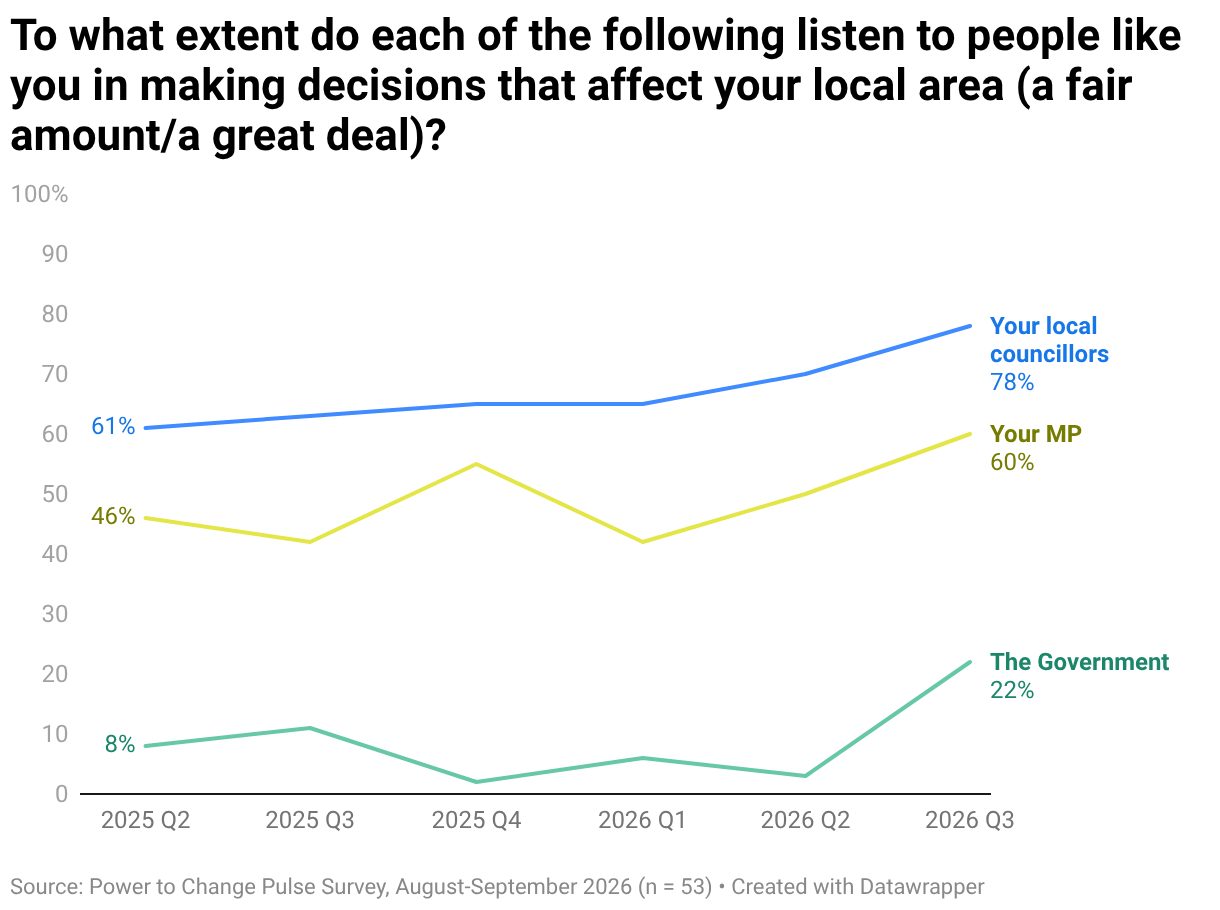
For the past year, our Pulse Survey has shown that, when it comes to decisions affecting their local areas, community businesses are far more likely to feel listened to by local councillors or their MPs than by central government.
That remains true, but this quarter we saw a notable shift: a much higher proportion of community businesses said they feel central government listens to them (22%), compared to previous quarters.

Have cookies disabled? View this chart as an image.
Community businesses, rooted in the neighbourhoods they serve and trusted by their surrounding communities, can act as an important barometer of whether the government’s messages are landing. And while confidence in being listened to remains low overall, this increase suggests the government’s focus on local growth and devolution is resonating.
This is even more apparent when examining community businesses’ current view of politics. When asked whether politics can help bring about local change, the vast majority (83%) agreed.
While many drew a natural connection between central policy driving local practice or central funding benefiting local places, several referred directly to the current national conversation on devolution when reflecting on why they agreed. One community business noted it is ‘great for North to be recognised as often forgotten by London-centric decision makers’, and another stated, ‘We need someone who cares and actually understands local and not just Westminster, with decisions coming from ground level; Burnham does.’
But people aren’t feeling the difference in their places… yet
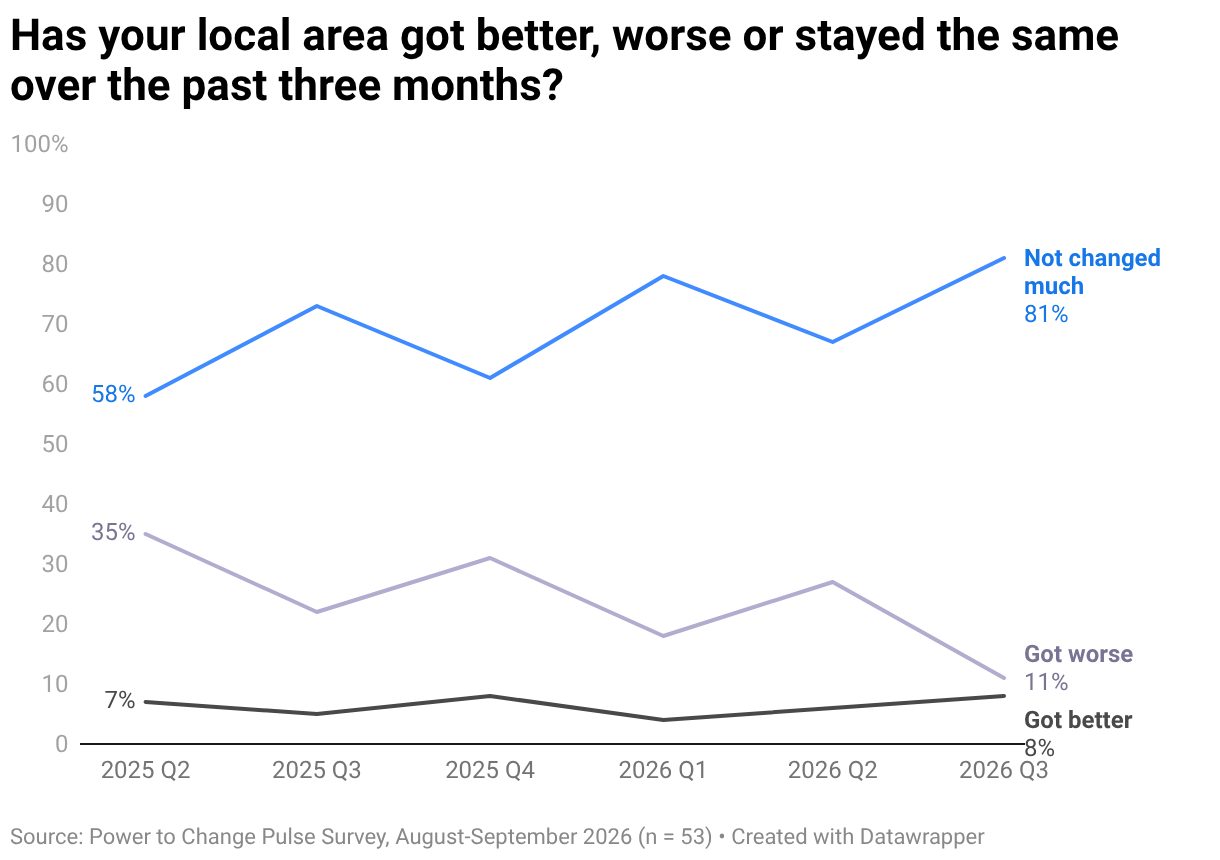
Despite greater optimism about politics, and feeling that government is listening, more than four in five community businesses told us their local area had remained largely unchanged – consistent with previous surveys.

Have cookies disabled? View this chart as an image.
For some, this reflects the reality that meaningful local change takes time. Others pointed to ongoing challenges including the cost of living, anti-social behaviour, declining local services and lack of housing or community spaces. As one respondent put it, there’s ‘the same number of empty shops – the vape shop has gone, thankfully’.
This is why the government’s announcement over the weekend, of a £210 million boost to regenerate the UK’s communities – including £125 million to transform derelict buildings, and £85 million to enable communities to take over neglected spaces and turn them into ‘community hubs, health centres, shared workspaces and local services’ – is so valuable.
It moves the devolution agenda beyond talking points to creating tangible opportunities for local communities and councils to transform their local high streets into vital civic spaces. It enables communities to see and feel their local areas getting better. And with the right support and tools, it will enable community businesses to exemplify the stewardship role they already take on with local assets.
The details of devolution matter
The implementation of devolution at the local and regional level is crucial – community businesses are looking for tools and processes to help them meaningfully shape its future.
When we asked community businesses what governments could do to help people feel they have a genuine say in decisions that affect them, many community businesses called for more meaningful, on the ground engagement – going beyond occasional consultations to processes like citizens’ assemblies, people’s panels, neighbourhood governance structures and participatory decision making.
Several respondents pointed to examples where local government is already experimenting with more participatory approaches and argued that these models should become more common. Importantly, community businesses saw themselves as part of the solution: ‘Community businesses provide ready and waiting resource for both Local and National Government to better, more meaningfully engage communities – in two-way, reciprocal dialogue […] All local government consultation should involve community businesses – as both consultees and facilitators.’
Rather than seeing devolution as solely a transfer of powers between tiers of government, they saw it as an opportunity to rethink how decisions are made altogether – and as trusted organisations, community businesses could bridge the gap between residents, public institutions and decision-makers.
Some community businesses also raised the alarm on the institutional transfer of power as it currently stands, with concerns about local authority restructuring and whether larger strategic bodies might feel further removed from neighbourhoods and communities. One respondent worried that larger authorities could make meaningful engagement more difficult if communities are not deliberately brought into decision-making processes: ‘We worked very closely in partnership. Now they have no interest in working with us.’
Community businesses want to see devolved institutions succeeding, but in its implementation, they also want those institutions to be connected to the communities they serve.
The imminent choice for effective devolution is partnership
The government’s devolution agenda presents a significant opportunity.
Our latest survey suggests community businesses hear this message and eagerly share the ambition behind it. But combined authorities, mayors and strategic local leaders can also go further in becoming powerful champions of community-led renewal.
By working directly with community businesses and residents, and by implementing meaningful mechanisms and processes for engagement, they can ensure devolved powers translate into better local decisions, stronger neighbourhoods and more inclusive growth.
Our seventh survey was carried out between 10 August – 1 September 2026 and had 53 respondents. The online survey was sent to our mailing list of community businesses. The results of this survey are not representative of the views of the entire community business sector.