“For ten glorious years Stretford Public Hall has belonged to us, the people. Not just in name, but in practice and in love and in joy.
A place reclaimed, reimagined, reinvigorated, reinvented and returned to us for ten great years and for endless time to come.”
Earlier this year, Friends of Stretford Public Hall celebrated its 10th birthday in the same spirit as we began: together. Except this time, we were in the magical ballroom of a building transformed, a place we now own as a community. The day was a frenzy of colour and sound – children throwing themselves into circus skills, live music filling every corner, and speeches that moved people to tears. A magnificent cake was cut and shared, while old friends and new neighbours danced late into the night. The Hall swelled with more people than we could ever have imagined – over 4,000 through the doors in a single day. There were familiar faces who had been there from the start, standing alongside families visiting for the very first time.
A decade earlier, my own connection to the Hall started almost by chance. At an event in Manchester, I found myself in conversation with Annoushka Deighton, the founding chair of a new community co-operative. She and two other parents from the local primary school had set up Friends of Stretford Public Hall when whispers spread that the building might be sold off. They had already overseen a remarkable grassroots campaign to secure its future in community ownership and were beginning to face the next challenge: how to turn that bold idea into a sustainable reality.
And those ten years – from a grassroots campaign to a thriving community business – curiously mirror the lifespan of Power to Change. Both journeys began with a leap of faith: in our case, with local people daring to believe that they could reinvent a much-loved building, and in Power to Change’s, a national funder recognising that communities themselves could lead a new wave of local economic renewal. For both organisations, what followed was not a straight path, but a decade of hard work, creativity and resilience — all the while discovering that extraordinary things can happen when communities have a real stake in their neighbourhoods.
From crisis to possibility (2014 – 2016)
The starting point for Friends of Stretford Public Hall was not celebration, but crisis. In 2014, Trafford Council started to explore the prospect that the Grade-II listed venue, once gifted to the people of Stretford by industrialist John Rylands, could be sold off. For many residents, the hall was more than a building: it was a cherished place that had hosted dances, concerts and community gatherings. Despite years of neglect and its recent use as council offices, to lose the Hall completely to private ownership would have been an almost fatal blow to a neighbourhood that had already been marked by years of under-investment, with a growing sense that nothing positive ever happened in Stretford.
But actually, this was a story being repeated across the country. The 2011 Localism Act had, in theory, given communities new rights to protect and bid for assets and services. At the same time, though, austerity was driving councils to close services or sell buildings at an alarming rate. It often felt like papering over the cracks just as the ground was giving way beneath communities.
Even so, glimmers of light began to appear. The transfer of Stretford Public Hall into community ownership took place at the very moment Power to Change was established as a newly endowed trust in 2015. Power to Change’s work was pointing to another way forward. It showed that communities weren’t limited to a simple choice between state or private ownership, but could try something different: collective, community-led enterprise. For Stretford, it was a step towards proving that things could change in a place that had seen little investment for so long. Our vision was for Stretford Public Hall to become a unique and thriving multi-purpose venue at the heart of Stretford, owned and run by the local community.
And at a national level, it marked a new wave of recognition and support for community business.
The power of community investment (2017-2019)
Once the Hall was in community hands, the central challenge was how to turn an iconic but neglected building into a sustainable business. At the heart of the business plan was the need to transform the magnificent ballroom into a multi-purpose space – somewhere that could host weddings and conferences to provide financial security, while also realising its potential as a welcoming venue for community events and cultural activity.
As a new organisation, we had no funding in place for the works, so in 2017 we launched a community share offer to raise the bulk of what was required. In less than two months, more than 800 people invested over £250,000 – an overwhelming response that encapsulated the strong sense of community in the neighbourhood. For most, the investment wasn’t just about money; it was about making a meaningful connection to the Hall and having a real say in its future.
Crucially the offer became one of the pilots for Power to Change’s new Community Shares Booster Programme, which match-funded what was raised from the local community through an equivalent investment on identical terms. The Booster programme marked a major breakthrough for institutional investment in the community business sector and has collectively gone on to back over 100 other communities with millions of pounds, stimulating £3.65 of community investment for every £1 invested by Booster and growing the community shares market considerably over the last few years.
Rising to the challenge (2020- 2022)
When the pandemic hit, Stretford Public Hall had to change direction almost overnight. With the ballroom closed and most of our income gone, we focused on what the community needed most. With the help of our dedicated volunteers, we distributed foodbank parcels, ran a phone line for people who needed advice or support, and delivered shopping and prescriptions to residents who were shielding. Our ability to mobilise rapidly and get support where it was needed most underscored how embedded the Hall was in the community. It also proved to the council we were a reliable partner organisation, that they could trust us to respond quickly and innovatively.
That experience shaped what came next. Trafford Council has since continued to fund the Hall as part of its network of community hubs, and we’ve taken on roles from supporting Ukrainian refugees to working with others on the Trafford Poverty Truth Commission.
Power to Change’s support was also vital during this period, actively recognising their role in helping the whole community business sector navigate the pandemic by distributing millions in emergency funding, creating spaces for peer support, and making sure national decision-makers understood the role community businesses were playing. Fundamentally at a time when so much was shutting down, the community business sector didn’t retreat but rather stepped forward, showing that community-led organisations could be relied on when it mattered most.
Building resilience (2023-2025)
Just as we began to recover from the pandemic, another challenge arrived. Rising energy bills and the wider cost-of-living crisis hit hard, and demand for support at Stretford Public Hall kept growing. People came to us for warm spaces, weekly meals, advice and referrals, and practical help when money was tight. The Hall became a trusted hub for residents who might not have known where else to turn.
This picture was repeated across the country. Community businesses were juggling soaring costs with growing demand, often in older, energy-hungry buildings like ours. Power to Change’s Resilient Communities Fund — a rapid, flexible programme — gave us breathing space to cover bills and the confidence to plan for longer-term energy resilience. For us, and for many others, it showed the value of funding that trusts communities to decide what they need most.
At the Hall, this crisis also pushed us to think harder about the building itself. We identified a critical first phase of works to underpin a wider capital programme that would secure the Hall’s long-term sustainability. This included major roofing upgrades, improved drainage to cope with heavier rainfall, new insulation across the roof voids, and replacing outdated strip lighting with low-energy LEDs. To make this possible, we returned once again to the community with a new share offer — inviting local people to invest not just in repairs, but in the future resilience of the building.
Taking Back the High Street (2020–2025)
In 2020, Trafford Council secured £17 million from the Future High Streets Fund to redevelop Stretford Town Centre, naming Stretford Public Hall as a core community asset in its bid. The investment, alongside a joint venture with developer Bruntwood to buy Stretford Mall – the struggling shopping centre that dominated the ‘high street’ – suddenly enabled the wholesale renewal that Stretford so acutely deserved.
At the same time, we joined Power to Change’s Community Improvement District pilot, which led to the creation of the Stretford Town Centre Forum in 2023. The Forum brought together the council and Bruntwood alongside community organisations and independent businesses to attempt to give them a more meaningful say in the redevelopment plans.
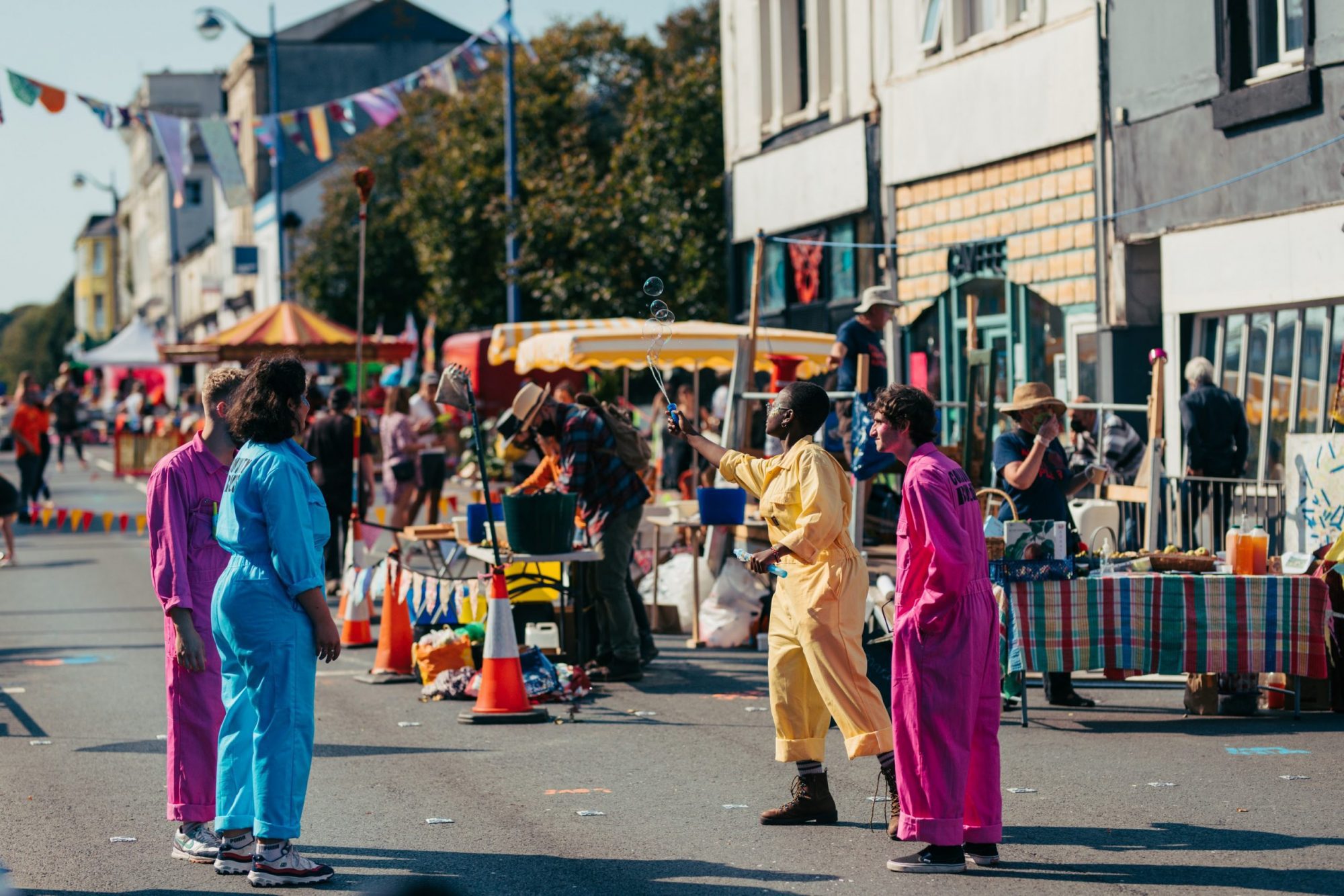
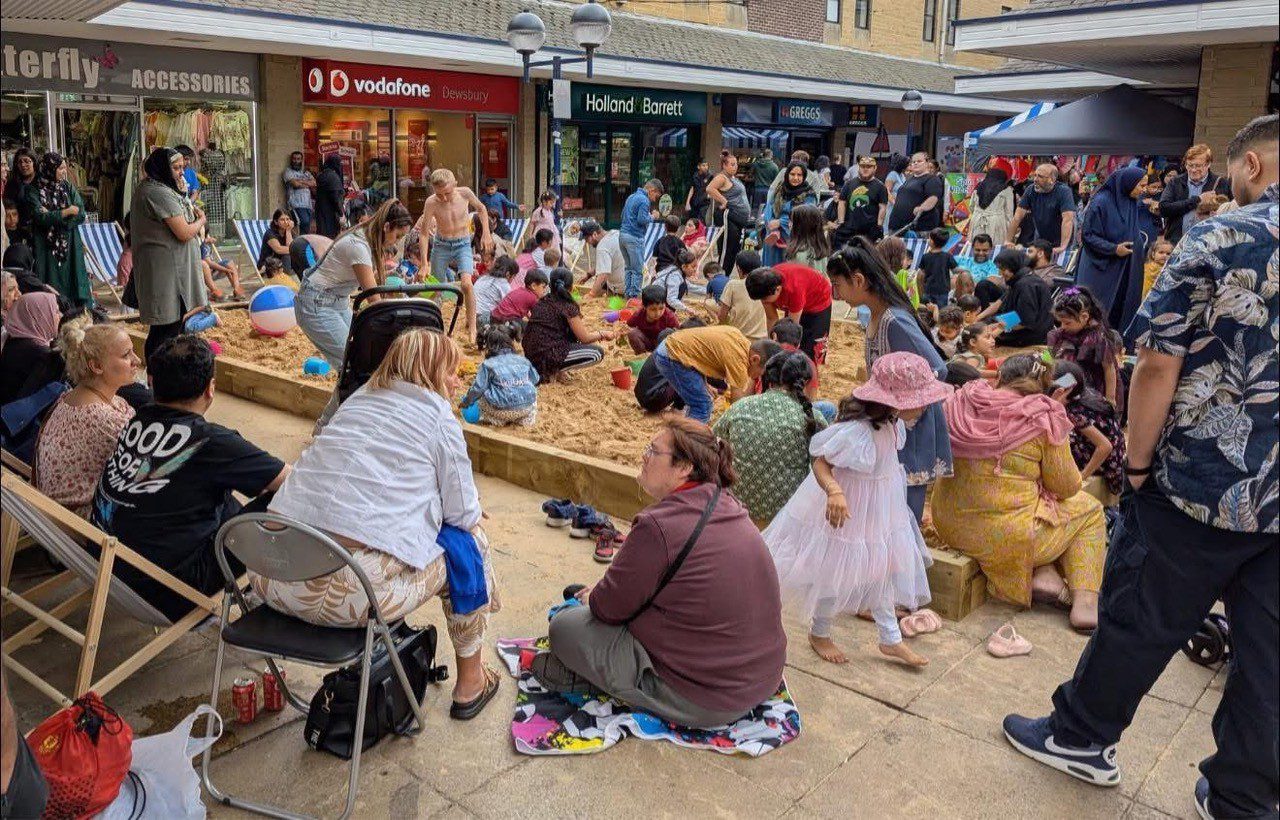
The potential for the Forum to influence the regeneration scheme has been a challenge, but in the short term, an opportunity arose to work together on a plan to celebrate their town centre. Friends of Stretford Public Hall worked with the Town Centre Forum to deliver the first “Stretfest”, a neighbourhood-wide festival involving local businesses, community spaces and groups from across Stretford. By its second year in 2025, Stretfest had attracted more than 10,000 visitors across the town centre and mall, showing the power of community-led activity to breathe life into a town centre that was suffering from considerable overhaul. Our experience, and those of communities across the country, show that lasting renewal depends not just on investment in buildings, but on communities shaping and animating the places they call home. It’s no surprise that high streets remain a key focus for Power to Change going forward, given the value of community business in underpinning thriving local economies. And for us at Stretford Public Hall, the town centre will remain just as central to our future – making sure that community voices and community activity sit at the heart of Stretford’s regeneration.
Looking to the next ten years
The past decade has shown what’s possible when communities are trusted with the places that matter to them, and when national support helps to back that ambition. For Stretford Public Hall, the journey from uncertainty to ownership, from survival to celebration, has been mirrored by Power to Change’s own path in growing the community business movement.
Both stories underline the same lesson: community ownership is not just about saving buildings, but about creating anchors for local economies, spaces for civic life, and confidence that things can change for the better.
Looking ahead, the challenges won’t be small — from climate action to inequality, to the uncertain future of town centres. But the experience of the last ten years shows that communities have the imagination and determination to rise to them, provided they have the right support. For Stretford Public Hall, that means hopefully deepening our role in the regeneration of the town centre, alongside realising the future potential of our wonderful building through continued capital investment. Alongside Power to Change, ultimately, we hope we can continue to show that community business can be a foundation for thriving local economies.
Simon Borkin is chair of Friends of Stretford Public Hall, and a freelance practitioner supporting other community businesses and social sector organisations to start, grow and contribute to a sustainable and inclusive economy.