The Stonehouse area of Plymouth has a diverse community and a rich history. It also has a lot of disadvantage and high crime rates. At its heart is Union Street, the main road linking Devonport with the city centre, once home to wealthy families, prominent business and hugely popular entertainment venues.
Fast forward to recent times and like so many high streets, 25% of the land is lying empty along the street, much of it boarded up or falling into disrepair; a complex mix of property as investment portfolio and multiple owners, many from outside the city.
As the then chair and vice chair of Stonehouse Action Group, Hannah Sloggett and Wendy Hart started hosting Union Street parties to bring local people together. Hannah recalls: “Residents reported feeling sad to see it degenerate, they felt unsafe at night. Years of neglect had given a sense of permission for anti-social behaviour and a lack of care when people were already struggling with a lot of other things in their lives.
“As a community we wanted to pull together and find a different way to address some of those issues. Traditional regeneration hadn’t had the intended impact on the area. If anything, it was creating divides and edges. We weren’t really seeing the ripple effect, so we decided to get together and find a different way.”

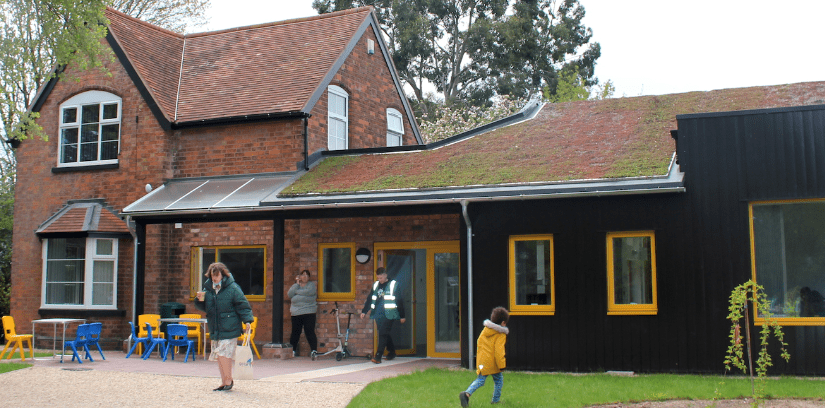
That different way is Nudge Community Builders, now a team of five staff backed by volunteers, tenants, networks and a board – all of whom work or live locally. On its eighth ‘nudge’ they’ve already brought three buildings on the street back into community use. One is The Plot, an alternative shopping arcade, home to 17 small businesses including Jabulani, a food court supporting female entrepreneurs from minoritised communities to get started with their aspirations to run a food business.
Their latest acquisition is the Millennium building, empty for 15 years, it holds special memories for people having been a dance hall, roller disco and much-loved nightclub.
“Power to Change supported us to acquire the Millennium building. They worked with us to have a grant pre-agreed, so we were able to buy in quite a complex market. The process was on and off for about three and a half years, and they just stood by us. They were brilliant. They really understood the practical challenges of tackling tricky ownership and came alongside us to support us to find a different way.”

“That’s really unusual for a funder – trusting us and taking the time to understand what an organisation is trying to achieve. We’ve bought the building fifty/fifty with Eat Work Art who run a number of buildings in London. We’re learning from them; they’re learning from us and together we are in a stronger position to push that building forward.
“Power to Change have also helped us to grow into a strong community business by supporting some of our core costs to make sure Wendy and I can be strong leaders. We both live within five minutes of the street. A developer isn’t going to stand at the school gates being asked whether they’ve created the jobs they said they would or put the windows in they promised.
“The level of accountability when you run a community business is off the scale! It’s good though. At the back of The Plot is a big block of flats and someone said: ‘I think you have changed our community for ever and I feel proud about saying where I live now’. We get lots of that. So much love. You’ve got to let that go in or all the hard stuff takes over. Shows we are on the right track. It can be more than one special building; this is a movement of people.”